What are the indicators of poverty

Christopher Harper
Published Jun 25, 2026
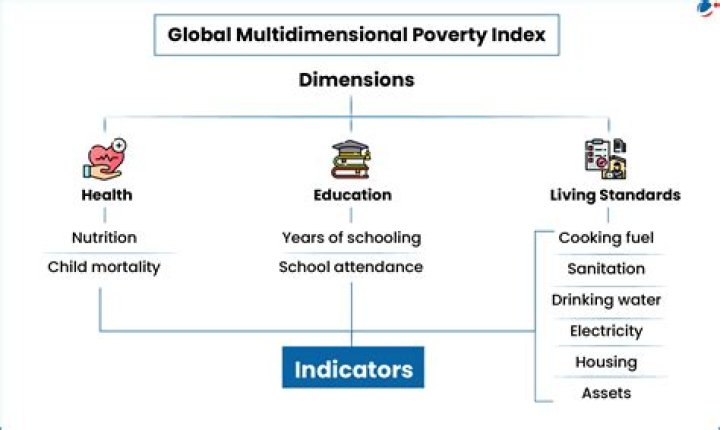
The Multidimensional Poverty Index (MPI) is published by the UNDP’s Human Development Report Office and tracks deprivation across three dimensions and 10 indicators: health (child mortality, nutrition), education (years of schooling, enrollment), and living standards (water, sanitation, electricity, cooking fuel, floor …
What are the four indicators of poverty?
Mostly, they analyse poverty on the basis of levels of income, consumption and other indicators such as illiteracy level, lack of job opportunities, lack of general resistance because of malnutrition, lack of access to healthcare, safe drinking water and sanitation.
What is the biggest indicator of poverty?
Poverty typically is measured by purchasing power or per capita expenditures made by the household, in the form of poverty rates or expenditure quintiles. Purchasing power has a strong correlation to most other living condition indices and is therefore used as a main indicator of poverty and vulnerability.
How many indicators of poverty are there?
Poverty is looked through social indicators like: Illiteracy level. Lack of general resistance due to malnutrition. Lack of access to health care.What is poverty income indicator?
The World Bank defines poverty in absolute terms. The bank defines extreme poverty as living on less than US$1.90 per day. (PPP), and moderate poverty as less than $3.10 a day. It has been estimated that in 2008, 1.4 billion people had consumption levels below US$1.25 a day and 2.7 billion lived on less than $2 a day.
What are the 5 causes of poverty?
- INEQUALITY AND MARGINALIZATION. …
- CONFLICT. …
- HUNGER, MALNUTRITION, AND STUNTING. …
- POOR HEALTHCARE SYSTEMS — ESPECIALLY FOR MOTHERS AND CHILDREN. …
- LITTLE OR NO ACCESS TO CLEAN WATER, SANITATION, AND HYGIENE. …
- CLIMATE CHANGE. …
- LACK OF EDUCATION. …
- POOR PUBLIC WORKS AND INFRASTRUCTURE.
Which is not a indicator of poverty?
literacy level is not considered as a social indicator of poverty.
What are the 10 causes of poverty?
- #1. Lack of good jobs/job growth. …
- #2: Lack of good education. The second root cause of poverty is a lack of education. …
- #3: Warfare/conflict. …
- #4: Weather/climate change. …
- #5: Social injustice. …
- #6: Lack of food and water. …
- #7: Lack of infrastructure. …
- #8: Lack of government support.
Are indicators?
Indicators are substances whose solutions change color due to changes in pH. These are called acid-base indicators. They are usually weak acids or bases, but their conjugate base or acid forms have different colors due to differences in their absorption spectra.
What are the 3 types of poverty?- Absolute poverty.
- Relative Poverty.
- Situational Poverty.
- Generational Poverty.
- Rural Poverty.
- Urban Poverty.
What is poverty and its causes?
Poverty is said to exist when people lack the means to satisfy their basic needs. … Poverty has been associated, for example, with poor health, low levels of education or skills, an inability or an unwillingness to work, high rates of disruptive or disorderly behaviour, and improvidence.
What are the 3 types of indicators?
Indicators can be described as three types—outcome, process or structure – as first proposed by Avedis Donabedian (1966).
What are types of indicators?
- Input indicators. These indicators refer to the resources needed for the implementation of an activity or intervention. …
- Process and output indicators. Process indicators refer to indicators to measure whether planned activities took place. …
- Outcome indicators. …
- Impact indicators.
What are two examples indicators?
Some examples of natural indicators are turmeric, grape juice, red cabbage, cherries, onion, beetroot etc. Synthetic indicators are indicators which are synthesized in the laboratory. Examples of synthetic indicators include phenolphthalein, methyl orange etc. litmus paper is also an example of synthetic indicator.
What defines poverty?
Essentially, poverty refers to lacking enough resources to provide the necessities of life—food, clean water, shelter and clothing. … In government circles, poverty is often further defined as “absolute poverty” and “relative poverty” (more on that below). Every country has its own measure for poverty.
What is the solution of poverty?
Federal governments can achieve this by rebuilding their infrastructures, developing renewable energy sources, renovating abandoned housing and raising the minimum wage. By raising the minimum wage in existing jobs, companies would combat recent inflation in both developed and developing countries.
What are the elements in culture of poverty?
traits that characterize the culture of poverty. The principal ones may be described in four dimensions of the system: the relationship between the subculture and the larger society; the nature of the slum community; the na- ture of the family, and the attitudes, values and character structure of the individual.
What are the 4 types of indicators?
- Trend indicators. These technical indicators measure the direction and strength of a trend by comparing prices to an established baseline. …
- Momentum indicators. …
- Volatility Indicators. …
- Volume Indicators.
How many indicators are there?
There are four main types of technical indicators: Trend Following, Oscillators, Volatility and Support/Resistance.
What is a good indicator?
Characteristics of good indicators Valid: accurate measure of a behaviour, practice, task that is the expected output or outcome of the intervention. Reliable: consistently measurable over time, in the same way by different observers. Precise: operationally defined in clear terms.