What started the second industrial revolution

Daniel Johnston
Published Jun 28, 2026
The main causes of the second industrial revolution were due to: natural resources, abundant labor supply, strong government policy, new sources of power, railroads and American inventors and inventions.
What is the 2nd Industrial Revolution and why did it happen?
Unprecedented Urbanization. Between 1820 and 1860, the visual map of the United States was transformed by unprecedented urbanization and rapid territorial expansion. These changes mutually fueled the Second Industrial Revolution which peaked between 1870 and 1914.
What caused the Industrial Revolution to begin?
Historians have identified several causes for the Industrial Revolution, including: the emergence of capitalism, European imperialism, efforts to mine coal, and the effects of the Agricultural Revolution. … Often, laissez-faire capitalism is also referred to as free market capitalism or market capitalism.
When did the second industrialization start?
The second Industrial Revolution is usually dated between 1870 and 1914, although a number of its char- acteristic events can be dated to the 1850s.Where did the 2nd Industrial Revolution start?
What is called the first Industrial Revolution lasted from the mid-18th century to about 1830 and was mostly confined to Britain. The second Industrial Revolution lasted from the mid-19th century until the early 20th century and took place in Britain, continental Europe, North America, and Japan.
What technology initiated the second industrial revolution?
Industry and technology. A synergy between iron and steel, railroads and coal developed at the beginning of the Second Industrial Revolution. Railroads allowed cheap transportation of materials and products, which in turn led to cheap rails to build more roads.
What happened in Second Industrial Revolution?
The Second Industrial Revolution was a period when advances in steel production, electricity and petroleum caused a series of innovations that changed society. With the production of cost effective steel, railroads were expanded and more industrial machines were built.
How did the second industrial revolution change society?
Rapid advances in the creation of steel, chemicals and electricity helped fuel production, including mass-produced consumer goods and weapons. It became far easier to get around on trains, automobiles and bicycles. At the same time, ideas and news spread via newspapers, the radio and telegraph.What did the first and second industrial revolution have in common?
What did the first and second industrial revolutions have in common? … Both revolutions depended on vast imports of goods, and both led to huge economic growth. The first industrial revolution gave rise to textiles, railroads, iron, and coal. The second was built on steel, electricity, chemicals, and petroleum.
Why did Industrial Revolution began in Britain?The first Industrial Revolution began in Great Britain after 1750. … The profits Britain had enjoyed due to booming cotton and trade industries allowed investors to support the construction of factories. British entrepreneurs interested in taking risks to make profits were leading the charge of industrialization.
Article first time published onWhat was invented during Industrial Revolution?
Three of the most influential of these inventions were the coke fueled furnace, steam engine, and spinning jenny; all of which increased production capabilities large amounts in many parts of Europe.
What caused Industrial Revolution in Britain?
Many different factors contributed to the rise of the Industrial Revolution in Britain. The new inventions, access to raw materials, trade routes and partners, social changes, and a stable government all paved the way for Britain to become an industry-driven country.
What were the 1st 2nd and 3rd Industrial Revolution?
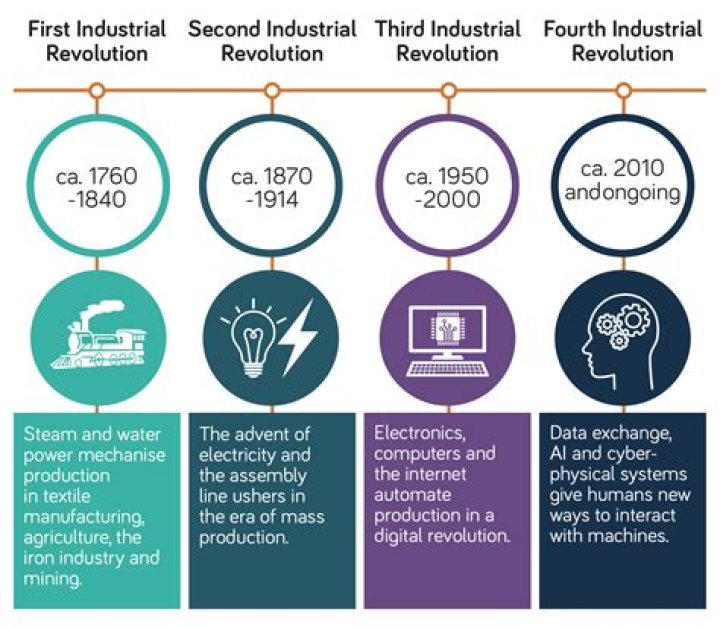
The First Industrial Revolution used water and steam power to mechanize production. The Second used electric power to create mass production. The Third used electronics and information technology to automate production.
When was the 3rd Industrial Revolution?
Beginning in the 1950s, the third industrial revolution brought semiconductors, mainframe computing, personal computing, and the Internet—the digital revolution.
Which invention was in use before the Second Industrial Revolution?
Trains were invented before the Second Industrial Revolution, but there were frequent accidents because slowing and stopping them was a cumbersome process.
What was the most important invention of the Second Industrial Revolution and why presentation?
The telephone was the most important invention of the Second Industrial Revolution because it allowed for instant communication, communication by voice, and it paved the way for future inovations in telephone technology.
Who were the significant inventors of the Second Industrial Revolution?
Started by Eli Whitney, Samuel Slater, and others who developed simple machines and factories to create fabric, and machine parts.
How did the first and second industrial revolution differ?
Key Difference – First vs. Second Industrial Revolution. The key difference between first and second industrial revolution is that the first industrial revolution was centered on Textiles, steam power, and iron while the second was centered on steel, railroads, petroleum, chemicals and electricity.
How was the first industrial revolution different from the second quizlet?
Difference between first and second Industrial Revolutions: Second industrial revolution: was larger, the Second included the development of electricity, chemicals, oil, and steel. First Industrial Revolution transitioned from manpower to machine power.
How was the first industrial revolution different from the second Brainpop?
How was the first Industrial Revolution different from the second? The first led to the development of new inventions; the second did not. The first was centered in Britain; the second was centered in America. The first involved advances in transportation and communication; the second did not.
What were 5 positive effects of the Industrial Revolution?
- It developed the economy.
- It led to the emergence of machines.
- It caused the mechanization of agriculture.
- Communication and transportation improved dramatically.
- Telegraghs and railroads emerged.
When did Britain run out of wood?
In the middle of the sixteenth century Britain began to run out of wood. By 1700 it had converted almost completely to coal.
Why did Industrial Revolution first occur in England 11?
England was the first country to experience industrialization. Because it had been a politically stable country. There was abundance of natural resources like iron and coal in England. Iron and coal are necessary resources for the functioning of any industry.
What was the first industry to be industrialized?
The textile industry was also the first to use modern production methods. The Industrial Revolution began in Great Britain and many of the technological and architectural innovations were of British origin.
What were the 3 most important inventions of the Industrial Revolution?
The three most important inventions of the first Industrial Revolution include the steam engine, the spinning jenny, and the telegraph. The three most important inventions of the Second Industrial Revolution include the combustible engine, electricity, and the lightbulb.
What were the 5 most important inventions of the Industrial Revolution?
- #1 Spinning Jenny. The improved spinning jenny that was used in textile mills. …
- #2 Steam Engine. …
- #3 Power Loom. …
- #4 Sewing Machine. …
- #5 Telegraph. …
- #6 Hot Blast and Bessemer’s Converter. …
- #7 Dynamite. …
- #8 Incandescent Light Bulb.
What was invented in 1860?
DateInnovationCountry1861Hacienda La Esperanza Sugar Mill Steam EngineUSA1860Minot’s Ledge LighthouseUSA1867Mormon TabernacleUSA1864Moseley Wrought Iron Arch BridgeUSA
When was the 4th industrial revolution?
The Fourth Industrial Revolution (4IR) is a term coined in 2016 by Klaus Schwab, Founder and Executive Chairman of the World Economic Forum (WEF).
What are the 1st 2nd 3rd and 4th industrial revolution?
1st IR – use of metals, not just stone and wood – Bronze Age/Iron Age; 2nd IR – use of “steam” energy, not just animal/wind/water; 3rd IR – use of electricity; 4th IR – use of information technology.
When did the 4th Industrial Revolution start?
It also represents a social, political, and economic shift from the digital age of the late 1990s and early 2000s to an era of embedded connectivity distinguished by the omni-use and commonness of technological use throughout society (e.g. a metaverse) that changes the ways we experience and know the world around us.
What is 5th industrial revolution?
The Fifth Industrial Revolution (5IR) can be summarised as the combination of humans and machines in the workplace. … Previous generations had to adapt their lifestyle to what the machines could do. The Fifth Industrial Revolution is different. Human beings are now front and centre in the production process.