How do downdrafts form in ordinary cell thunderstorms

Andrew Mccoy
Published Jun 25, 2026
How do downdrafts form in ordinary cell thunderstorms? The raindrops evaporate from the dry air, now chills it. The air is colder and heavier than the air around it, begins to descend in a downdraft. The cold particles begin to melt, which chills the air and enhances the downdraft.
How do downdrafts form?
Warm, humid air masses away from significant weather fronts. … The air, now colder and heavier than the air around it, begins to descend as a downdraft. The downdraft may be enhanced as falling precipitation drags some of the air along with it. Why do ordinary cell thunderstorms most frequently form in the afternoon?
What is an ordinary cell thunderstorm and how does it form?
Also called a “pulse” thunderstorm, the ordinary cell consists of a one-time updraft and one-time downdraft. In the towering cumulus stage, the rising updraft will suspend growing raindrops until the point where the weight of the water is greater than what can be supported.
What two mechanisms lead to formation of downdrafts in thunderstorms?
Precipitation quickly begins to fall to the north, northeast, and east, as precipitation particles within the storm are carried downwind of the updraft core by the middle- and upper-level winds. When precipitation falls, evaporation cooling and drag lead to the formation of downdrafts.What are thunderstorm downdrafts?
Every thunderstorm also has a downdraft – that is where precipitation – rain and hail – falls from the storm. At the most basic level, there are two types of thunderstorm winds: 1) those associated with the UPDRAFT, and 2) winds associated with the DOWNDRAFT.
Why do downdrafts occur?
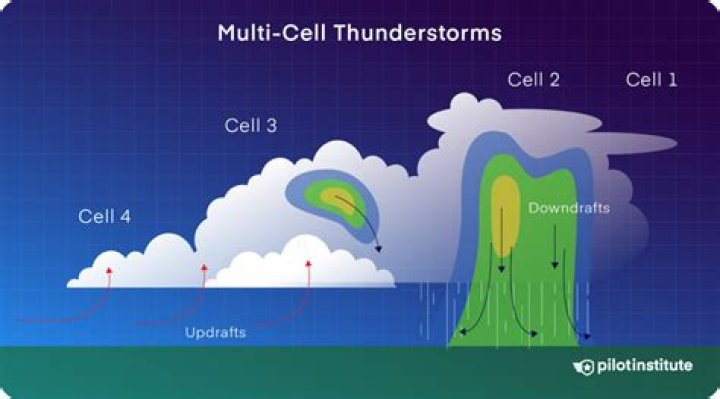
thunderstorms. …and ice becomes excessive, a downdraft starts. The downward motion is enhanced when the cloud particles evaporate and cool the air—almost the reverse of the processes in an updraft. At maturity, the cell contains both updrafts and downdrafts in close proximity.
What do downdrafts do?
These downdrafts, originating at high levels, contain cold, dense air that spreads out at the ground as a cold air wedge. The sharp changes in wind direction associated with downdrafts near the ground are a threat to aircraft during landing and takeoff.
How do thunderstorms form?
All thunderstorms need the same ingredients: moisture, unstable air and lift. Moisture usually comes from oceans. Unstable air forms when warm, moist air is near the ground and cold, dry air is above. … It pushes unstable air upward, creating a tall thunderstorm cloud.What causes the development of the downdrafts of a thunderstorm quizlet?
A sea breeze may lead the to formation of a thunderstorm if the cool sea breeze forces warm air to rise which creates a convection cell that creates strong updrafts that lead to a thunderstorm. … –Falling precipitation cools the air around it, forming downdrafts.
Why are downdrafts in thunderstorms cold?During descent, the melting of ice crystals and the evaporation of water droplets serve to cool, and thereby strengthen, the speed of the downdraft. Eventually, this descending column of cool, dense air reaches the surface and spreads out in all directions.
Article first time published onHow does a storm cell form?
Thunderstorms form when warm, moist air rises into cold air. … This circuit of rising and falling air is called a convection cell. If this happens a small amount, a cloud will form. If this happens with large amounts of air and moisture, a thunderstorm can form.
How does a multicell thunderstorm form?
Multicells. If relatively isolated thunderstorms develop when vertical wind shear becomes more “moderate,” they tend to become multicells. Multicell thunderstorms are a “group” or “family” of single cells at various stages of their life cycles.
How many stages does an ordinary thunderstorm have?
Thunderstorms have three stages in their life cycle: The developing stage, the mature stage, and the dissipating stage. The developing stage of a thunderstorm is marked by a cumulus cloud that is being pushed upward by a rising column of air (updraft).
Why do ordinary cell thunderstorms most frequently form in the afternoon?
Ordinary cell thunderstorms form more frequently in the afternoon because after the warm temperatures, the cold air aloft moves over the region. The cold air makes the atmosphere unstable and parcels push upward. … A squall line is an active line of thunderstorms that often produce strong gusty winds.
How are tornadoes formed?
The Short Answer: A tornado forms from a large thunderstorm. Inside thunderclouds, warm, humid air rises, while cool air falls–along with rain or hail. These conditions can cause spinning air currents inside the cloud.
What creates lightning?
In the early stages of development, air acts as an insulator between the positive and negative charges in the cloud and between the cloud and the ground. When the opposite charges build up enough, this insulating capacity of the air breaks down and there is a rapid discharge of electricity that we know as lightning.
What disaster is a combo of downdrafts and updrafts?
Relatively weak updrafts and downdrafts are found with non-severe showers and thunderstorms. The last possible combination is a storm with strong updrafts and downdrafts. These storms frequently produce destructive downbursts, hail, heavy rain, and tornadoes.
How are thunderstorms categorized?
The basic definition of a thunderstorm is a storm containing lightning and thunder. Thunderstorms come in a variety of shapes and sizes, but there are four categories in which thunderstorms generally fall. They are: single cells, multi-cell clusters, multi-cell lines, and supercells.
How does a thunderstorm downdraft help form a tornado?
As this spinning air is drawn into the storm’s updraft, the updraft rotates. Tornado formation is associated with a separate air stream, one that descends through a precipitation-driven downdraft and acquires horizontal spin by way of a horizontal variation of temperature along this air stream.
How do thunderstorms dissipate?
The Dissipating Stage Since warm moist air can no longer rise, cloud droplets can no longer form. The storm dies out with light rain as the cloud disappears from bottom to top. The whole process takes about one hour for an ordinary thunderstorm.
What is the source of updrafts?
Updrafts are found when a wind blowing at a hill or mountain has to rise to climb over the hill. Updrafts can also be caused by the sun heating the ground. The heat from the ground warms the surrounding air, which causes the air to rise.
During which stage of a thunderstorm are downdrafts and updrafts about equal?
The Mature Cumulus Stage Strong updrafts and downdrafts coexist. This is the most dangerous stage when tornadoes, large hail, damaging winds, and flash flooding may occur.
Why is sea breeze thunderstorm considered a type of air mass thunderstorm?
Why is a sea-breeze thunderstorm considered a type of air-mass thunderstorm? A sea-breeze thunderstorm is considered an air mass thunderstorm because sea-breeze thunderstorms are caused by temperature differences, and air-mass thunderstorms extreme temperature differences, They are caused by unequal heating.
Which stage of thunderstorm development is dominated by downdrafts group of answer choices?
As the updraft fades, the cloud becomes dominated by downdrafts in the dissipating stage as the storm “rains itself out” and dies. The birth, life, and death of a single-cell thunderstorm typically takes less than 45 minutes.
How is lightning formed in a thunderstorm?
Lightning is an electrical discharge caused by imbalances between storm clouds and the ground, or within the clouds themselves. Most lightning occurs within the clouds. … This heat causes surrounding air to rapidly expand and vibrate, which creates the pealing thunder we hear a short time after seeing a lightning flash.
What forms lightning in a thunderstorm cloud?
Lightning begins as static charges in a rain cloud. Winds inside the cloud are very turbulent. Water droplets in the bottom part of the cloud are caught in the updrafts and lifted to great heights where the much colder atmosphere freezes them.
What is the primary mechanism that triggers the updraft of an airmass thunderstorm?
What is the primary mechanism that triggers the updraft of an airmass thunderstorm? Why is wind shear a key environmental condition for severe thunderstorm formation? Strong winds cause the updraft to tilt and separate from the downdraft, allowing the inflow of warm, moist air to continue to feed the storm.
How is a supercell different from an ordinary single cell thunderstorm?
Thunderstorm cells come in two basic flavors: ordinary cells and supercells. Ordinary cells are a few miles in diameter and exist for less than an hour, whereas supercells are larger and can last for several hours. The supercell thunderstorm is a single-cell storm that almost always produces dangerous weather.
What are the three stages of formation of a single cell thunderstorm?
A basic thunderstorm (single cell) goes through three phases during its lifetime: cumulus, mature, and dissipating. This can last between 30 minutes to an hour.
What three things do you need for thunderstorm formation?
- Moisture,
- Instability, and.
- a lifting mechanism.
Which statement best describes how thunderstorms form?
Which statement best explains how thunder forms? The air within a lightning channel heats and cools rapidly, expanding and contracting. Which of the following lists the steps of a lightning stroke in the order they occur?